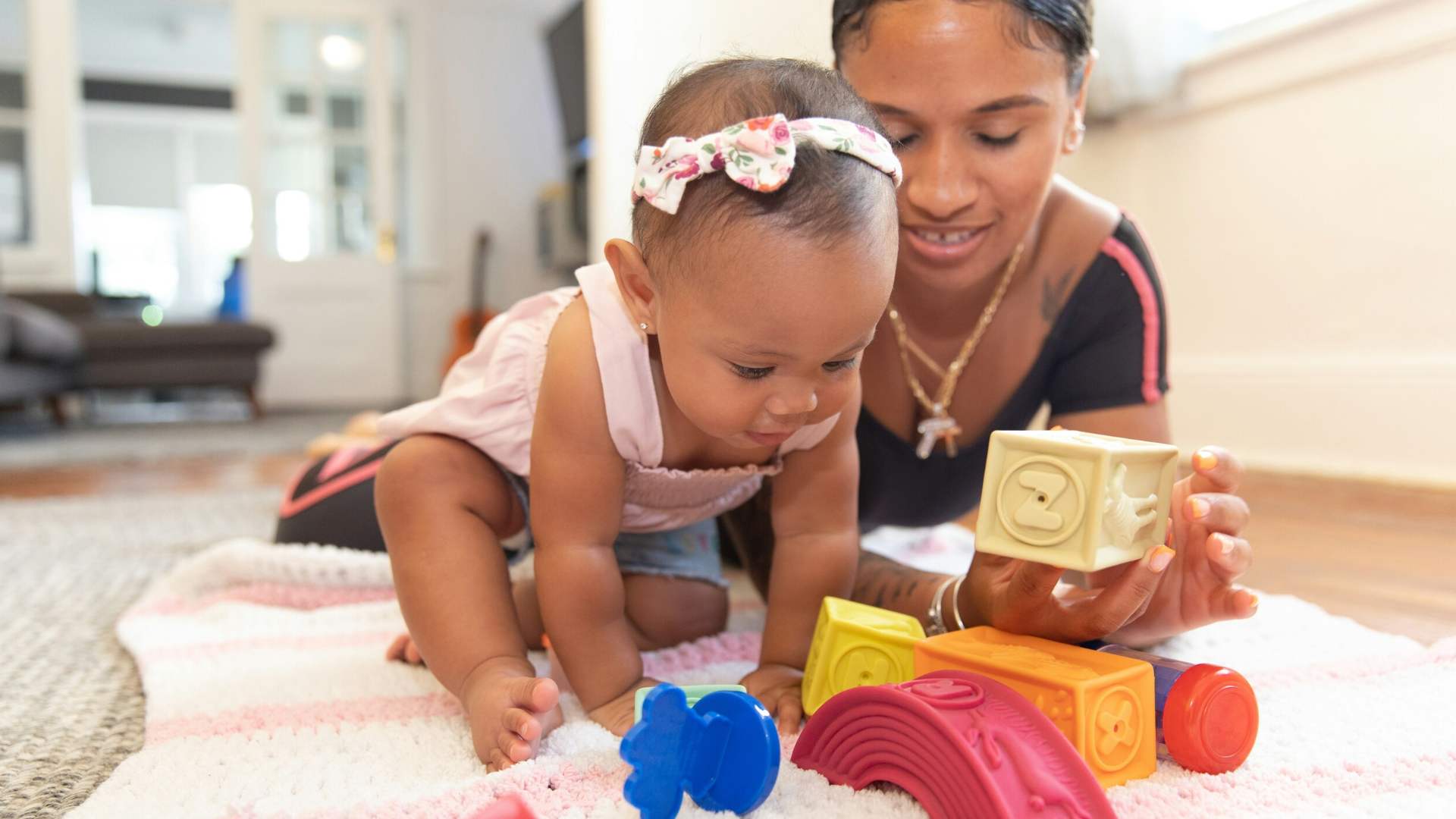
There is something incredibly special about watching your baby discover their hands.
In the beginning, those tiny fingers may seem to move almost on their own. But over the course of the first year, those early movements gradually become more intentional. Reaching turns into grabbing. Grabbing turns into transferring. And eventually, those little fingers begin working together with impressive precision.
These emerging fine motor skills are an important part of your baby’s development. They help build the foundation for future skills like feeding, dressing, drawing, playing with toys, and eventually using everyday tools.
The best part? You don't need complicated toys or elaborate activities to support this development. Your baby’s everyday environment provides plenty of opportunities to practice.
Here’s a look at how fine motor skills typically develop from about 3 to 12 months, along with a few simple activities you can try at home.
3 to 6 Months: Reaching, Batting & The Whole-Hand Grasp
Around 3 to 4 months, you may notice your baby beginning to open their hands more often and intentionally reach toward interesting objects. They may bat at toys hanging above them, reach across their body, or swipe at anything that catches their attention.
As they approach 5 to 6 months, babies begin developing a palmar grasp, using their entire hand and fingers to grab and hold objects.
And, of course, once they get something into their hands, it often goes directly into their mouth!
Mouthing is an important way babies explore their environment. They are learning about an object's texture, shape, size, and even how it feels against their gums.
The Milestone: Reaching for objects, batting at toys, grabbing objects with the whole hand, and bringing toys to the mouth.
Try This: A Texture Reach Activity
You can create a simple reaching activity using materials you already have at home.
Place your baby on their tummy and position a few safe, interesting textures within easy reach. You might use a soft washcloth, a smooth piece of fabric, or another baby-safe material.
Encourage your baby to reach, touch, and explore the different textures.
Why it helps: Reaching encourages your baby to coordinate their eyes, arms, and hands while also building the strength and control needed for future grasping.
Always supervise your baby closely and make sure anything within reach is large enough to prevent a choking hazard.
6 to 9 Months: Raking, Grabbing & Hand-to-Hand Transfer
As babies gain better control of their trunk, shoulders, and arms, their hands become more coordinated, too.
Between 6 and 9 months, many babies begin using a raking grasp, moving their fingers toward themselves to pull an object closer. You may see them rake at toys on the floor or use their fingers to scoop objects toward their palms.
Another exciting development is the ability to transfer objects from one hand to the other.
That simple-looking action actually requires coordination between both sides of the body and gives your baby a chance to practice controlling an object while maintaining their balance.
The Milestone: Grabbing objects, raking objects toward themselves, transferring toys from one hand to the other, and holding an object in each hand.
Try This: The Whisk & Fabric Activity
A clean kitchen whisk can become a simple sensory and fine motor activity.
Place a few large pieces of soft fabric inside the openings of the whisk and let your baby practice reaching, grabbing, and pulling them out.
As your baby works to retrieve the fabric, they are practicing different ways of using their fingers and hands.
Why it helps: Pulling and grabbing encourage hand strength, finger movement, coordination, and problem-solving.
As always, supervise closely and avoid small pieces or materials that could become a choking or strangulation hazard.
9 to 12 Months: Developing the Pincer Grasp
As your baby gets closer to their first birthday, you may notice a major change in the way they pick up objects.
Instead of relying primarily on their whole hand, babies begin using their thumb and index finger together to pick up smaller objects. This is called the pincer grasp.
You might see your baby pick up small pieces of food, point at pictures in a book, or use their index finger to explore buttons, openings, and other features of their environment.
The pincer grasp is an important developmental step because it gives babies much greater control over their fingers and hands.
The Milestone: Using the thumb and index finger to pick up objects, pointing with the index finger, and intentionally manipulating smaller objects.
Try This: The Tray Pick-Up Activity
A silicone ice cube tray can provide an easy setup for practicing fine motor skills.
Place a few large, baby-safe pieces of food, such as appropriately sized soft finger foods, into the individual compartments. Your baby can practice reaching into each section and picking up the pieces.
The separate compartments give your baby a reason to isolate their fingers and work on controlled grasping.
Why it helps: Picking up individual pieces encourages coordination between the eyes and hands while giving the thumb and index finger opportunities to work together.
Because foods and small objects can present a choking hazard, always follow age-appropriate feeding guidance and supervise your baby closely during this activity.
Fine Motor Skills Are Built Through Everyday Play
Your baby doesn't need a complicated activity schedule to develop their fine motor skills.
Reaching for a toy during tummy time. Grabbing a board book. Passing a toy from one hand to another. Picking up a piece of food. Pointing at a picture.
These small moments are all opportunities to practice.
As parents, caregivers, and educators, our job isn't to rush these milestones. It's to create safe, engaging opportunities for babies to explore, experiment, and discover what their hands can do.
Every baby develops at their own pace, and there can be a wide range of what is typical. Rather than focusing on whether your baby has mastered a particular skill on a specific day, look for those little signs of progress—the extra reach, the stronger grasp, the first successful transfer from one hand to the other.
From those very first purposeful reaches to the surprisingly precise movements of a one-year-old, your baby's hands are learning something new every day.
And sometimes, the simplest play is where the biggest discoveries begin.